Export Bearing Packaging and Delivery in 2026: Anti-Rust, Moisture and a Compliance Checklist
Packaging for 60-day ocean freight, plus the new delivery requirements brought by Section 301 tariffs and CBAM definitive regime
On 1 January 2026, the US completed a new round of Section 301 tariff increases on auto parts as the EU CBAM entered its definitive regime. This article covers anti-rust and moisture strategies, unitized packaging, and a compliance checklist for shipments to Europe and North America.
Two things relevant to every bearing exporter happened on 1 January 2026: the US completed a new round of Section 301 tariff increases covering automotive parts, and the EU's Carbon Border Adjustment Mechanism (CBAM) left its transitional period and entered the definitive regime, tying imports of iron-and-steel category products, bearings included, to authorized declarant status and emissions data. For export factories, delivery competitiveness has expanded from packed tight and rust-free to a full chain of packaging, data and documents. Packaging first, then compliance.
Anti-rust: the real enemy is container condensation
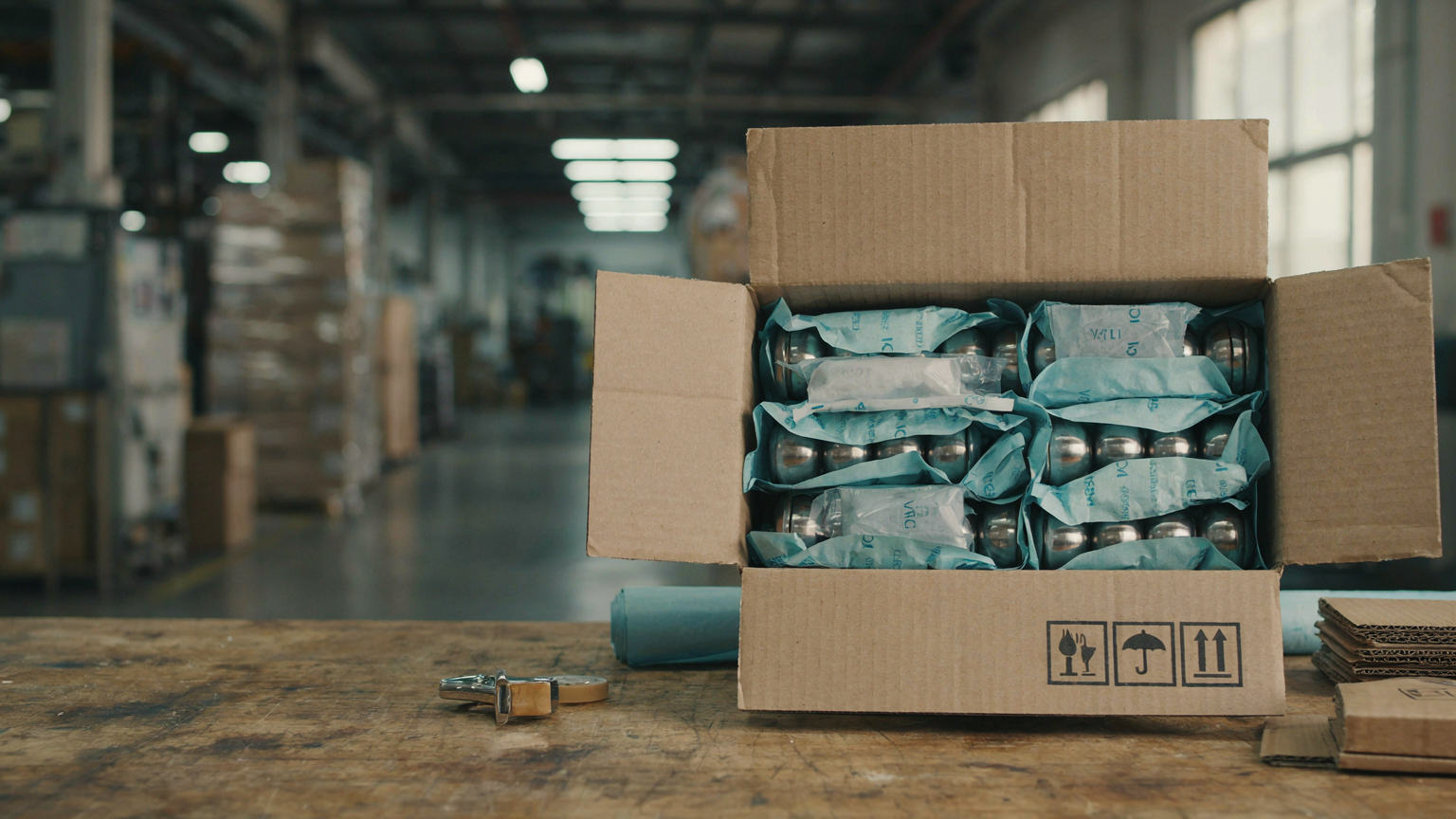
Over 60 days at sea, the main cause of bearing rust is not seawater but container rain — day-night temperature cycles condensing box humidity onto cargo surfaces. Countermeasures are designed in three layers: each bearing is wrapped in VCI (vapor-phase corrosion inhibitor) paper, whose volatile inhibitors form a film on the metal surface, effective on raceways and chamfers alike; cartons carry sufficient desiccant, with foil vacuum inner bags added on long routes or extended transshipment cycles; and shipments to high-humidity destination ports carry moisture indicator labels, so the receiver can judge on opening whether the cargo encountered moisture in transit.
Moisture control and unitization: from carton to container
Cartons use double-wall corrugated board selected by unit bearing weight, with stacking layers limited; pallets are standardized at 1.2 m × 1.0 m, secured with stretch wrap and corner boards; containers are loaded with ventilation channels kept clear and cargo kept off the box walls. Shipping marks are printed to destination-country customs requirements: product name, quantity, gross and net weight, country of origin, batch number — with the batch number matching the packing list, the entry point for later quality traceability.
2026 compliance checklist: Europe and North America
Beyond packaging, verify documents and data conventions along this checklist:
- US-bound: confirm HTS classification and the applicable Section 301 surtax rates with your buyer, and watch exclusion-list movements — the current extensions run to 10 November 2026, and whether they expire bears directly on landed cost;
- EU-bound: confirm the importer holds or has applied for CBAM authorized declarant status — in the definitive regime, unauthorized importers cannot clear iron-and-steel goods; under the relief arrangement, applications filed by 31 March 2026 allow imports to continue;
- Data support: provide product emissions-related data or supporting documents as required by EU buyers, and confirm data conventions with your steel supplier early;
- Documents: certificate of origin, packing list, material and performance test reports travel with the goods;
- Trade terms: specify FOB Tianjin/Qingdao or buyer-nominated terms in the contract to avoid ambiguous demurrage liability.
One piece of experience
We ship to more than 60 countries and regions every year, and the packaging problems we handle cluster in two types: transshipment cycles running past expectations and exhausting the desiccant, and buyer warehouse conditions mismatched with the packaging level. The first is solved with higher desiccant margins and a larger share of vacuum packing; for the second, give the factory the full port-to-warehouse chain at the order stage and set the packaging level against actual risk — far cheaper than a claim afterwards.